
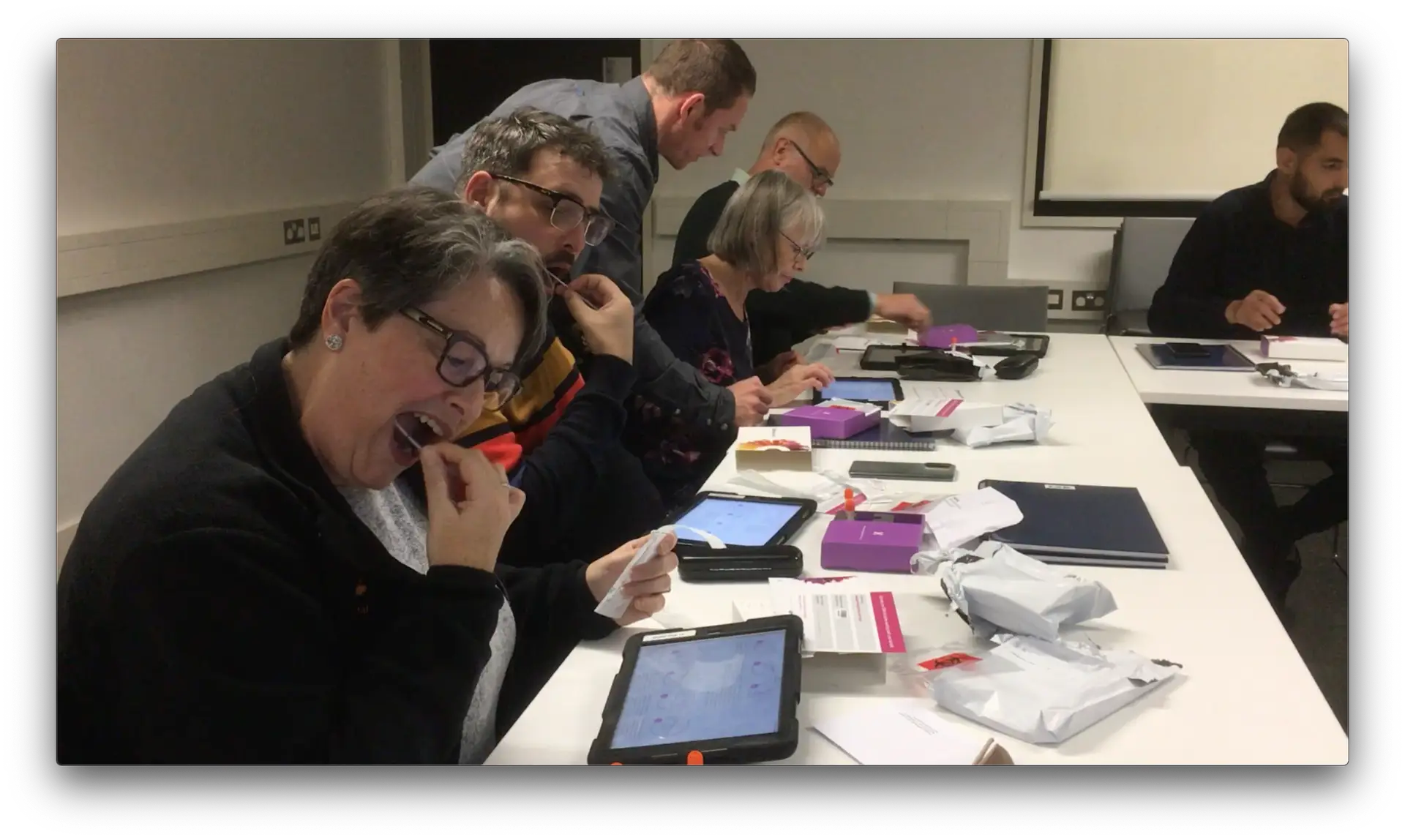
The instructions say not to eat, drink, or brush your teeth for thirty minutes before providing your sample. So I’m standing in my kitchen at 7am, mouth dry, holding a plastic tube and wondering whether my entire sense of identity is about to be confirmed or demolished by saliva.
This is how it starts. Not with some grand philosophical awakening, but with spit and a pre-paid envelope.
I’d ordered two ancestry DNA kits: one from MyHeritage, the other from CRI Genetics. The first promises to connect you with relatives you never knew existed and map your ethnicity across dozens of global regions. The second claims something bolder: a scientifically deeper test that traces your lineage beyond 5,000 years of human history, separating maternal and paternal lines into distinct migratory journeys across the planet.
Two companies asking the same question. Two very different ways of answering it.
Six weeks later, the emails arrive within days of each other. I open MyHeritage first. The colourful pie chart tells me what I half-expected: overwhelmingly European.
Scandinavian and Celtic heritage dominate, with smaller slices of German, French, and Iberian. Interesting, but not exactly earth-shattering for a man from the East Midlands with pale skin and a surname that sounds vaguely Norse.
Then I open CRI Genetics, and the picture gets stranger.
CRI’s deeper analysis confirms the European core but pushes further back in time, tracing my paternal line through migration routes I hadn’t imagined. Beyond the expected Scandinavian and Celtic markers, there’s Italian DNA. There’s Iberian. And then, further back in the timeline, like discovering a hidden room in a house you’ve lived in for decades: South East Asian. Japanese. Peruvian.
Peruvian.
I sit with that for a while. Somewhere in my deep ancestry, thousands of years ago, my forebears were not where I assumed they’d always been. They were somewhere else entirely. They were everyone, everywhere, all at once, long before that became a film title.
A subsequent, more targeted test confirmed something else: a high proportion of Viking DNA. Which at least explains why I feel so strongly about longboats.
Here’s what nobody tells you before you order: each company creates and names its genetic regions differently. MyHeritage might call something “North and West European” while CRI splits the same markers into five distinct populations with different names.
The results aren’t contradictory, exactly, but they require work. You have to sit down, compare, cross-reference, and match the overlapping data yourself.
This is not the simple, satisfying experience the marketing suggests. The adverts show tearful reunions and neat pie charts. The reality is more like being handed two maps of the same territory drawn by different cartographers, one in English and one in a language you half-remember from school.
CRI Genetics uses proprietary algorithms designed by molecular geneticist Dr. Alexei Fedorov, who was apprentice to Nobel Prize-winning scientist Walter Gilbert at Harvard. Their system analyses 527,414 hand-chosen genetic markers. They offer dual ancestry reports: “Recent Ancestry” reflecting the most recent 5-7 generations, and “Ancient Ancestry” reaching as far back as 1,000 years, plus an Ancestry Timeline revealing up to 50 generations back. But even they acknowledge the limitations: “It’s impossible to provide a 100% correct evaluation of your ancestry without having DNA samples from every ancestor going back 200,000 years.” What they offer instead is a “research-grade estimation” of biogeographical ancestry.
MyHeritage takes a different approach. Beyond ethnicity percentages across 79 top-level ethnicities, they offer “Genetic Groups”: clusters of people who share geographic origins across 2,100+ regions but may come from diverse ethnic backgrounds. A Genetic Group in Australia, for instance, might consist of individuals whose ancestors originated in England and Germany but who, after migrating to the same city, became a melting pot and created a new group of their own. You’re either a member or you’re not; there’s no percentage.
MyHeritage also offers something CRI doesn’t: a DNA matching service that connects you with potential relatives across the world, helping you build your family tree from genetic data outward. I’ve used it to trace my own family back seven generations so far, filling gaps that no parish record could.
But how much should we trust any of this? “What the tests really measure is not ancestry,” says Kostas Kampourakis, Biologist, University of Geneva. “It’s similarity with people in the database.” Professor Mark Thomas, Professor of Evolutionary Genetics at University College London, is blunter: “The idea that we can read our ancestry directly from our genes is absurd. Every gene in the human body has its own history. Genetic ancestry companies cannot tease the various possible histories apart without statistical tests.”
Dr Adam Rutherford, geneticist and author at University College London, puts it another way: “The idea that a company can reveal something fundamental about you is hard to resist, but these tests are selling cute answers to complex problems. Everyone wants to know where they are really from, but what does that question even mean?”
Despite their limitations, these tests are not useless. “It’s mostly about finding relatives,” says Kampourakis. When two people share long stretches of DNA, it is strong evidence of a recent common ancestor. “The genetics is a piece of evidence,” Rutherford adds, best used as a starting point rather than a conclusion.
A starting point. That phrase stuck with me. Because that’s exactly what happened next.
That said, CRI’s software for mapping maternal and paternal lineages separately was genuinely revelatory. Watching the two lines diverge across continents, tracing where my mother’s mothers walked versus where my father’s fathers settled, gave me something no pie chart could: a sense of movement. Of deep time. Of the sheer improbability that any of us ended up where we are.
Funded by Arts Council England and the Paul Hamlyn Foundation, the project brought together 18 participants from Derby’s richly diverse communities. Caribbean, Irish, Scottish, German, Scandinavian, Romanian, Dagestani, and members of the Derby Refugee Sanctuary. Over nine months, we explored three questions: Where are we from? Why are we in Derby? How did we come to be here?
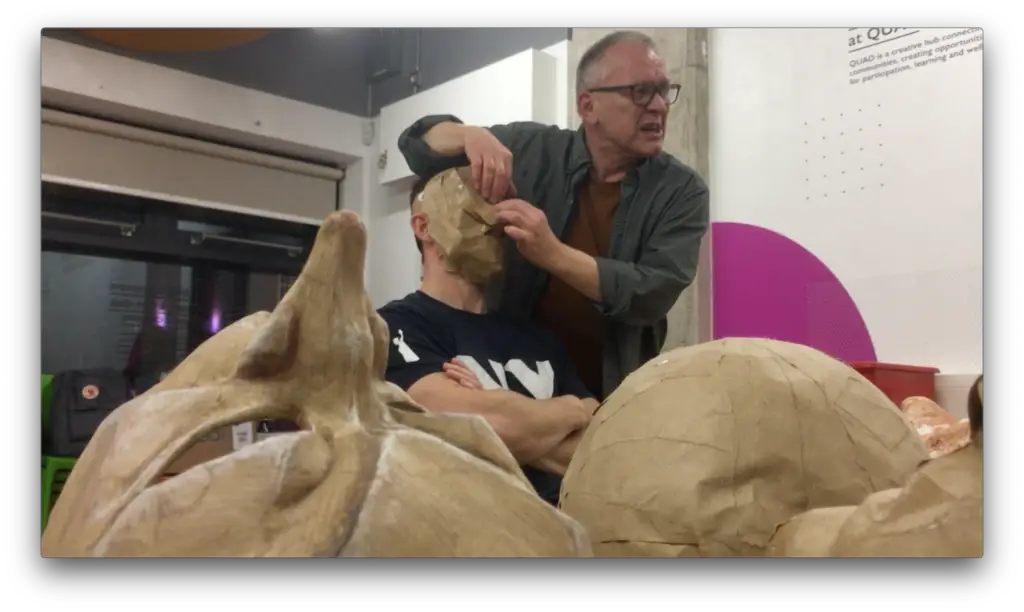
Each participant took an ancestral DNA test. Then, through a series of creative workshops, we used the results as a springboard. I assembled a team of practitioners: mask-makers, digital artists, folk musicians, choreographers, and theatre specialists. Together, we helped participants delve into their personal and cultural histories, combining DNA data with family memories, oral traditions, and inherited stories that no laboratory could ever sequence.
The results were extraordinary, and I don’t mean the genetic ones.
One participant, who had lived in Derby his entire life and identified strongly as English, discovered he was 98% British, with an overwhelming concentration in Lancashire. Far from being disappointed by the lack of exotic surprise, he found it profoundly moving. Generations upon generations, rooted in the same soil. There was a poem in that, and he wrote it.
Another participant discovered a rare and ancient Jewish heritage that nobody in their family had ever spoken about. Layers of silence, peeled back by science, then processed through art. A mask was made. A story was told.
Every participant created something: masks, paintings, poetry. As a group, they composed a new song and devised a theatre production that was performed at Derby Theatre. The collective work was a celebration of global roots and shared experience, built by people who might never have spoken to each other on the street.
“This project has seriously changed my life,” says James Filby, one of the Ancestories participants. It’s not a throwaway line. When you watch someone discover that their genetic heritage connects them to places and peoples they never imagined, then witness them transform that discovery into a mask or a poem or a moment on stage, you understand what James means. The change isn’t in the DNA. It’s in what you do with knowing.
The exhibition needed to feel like discovery. Like descending into something ancient and emerging changed.
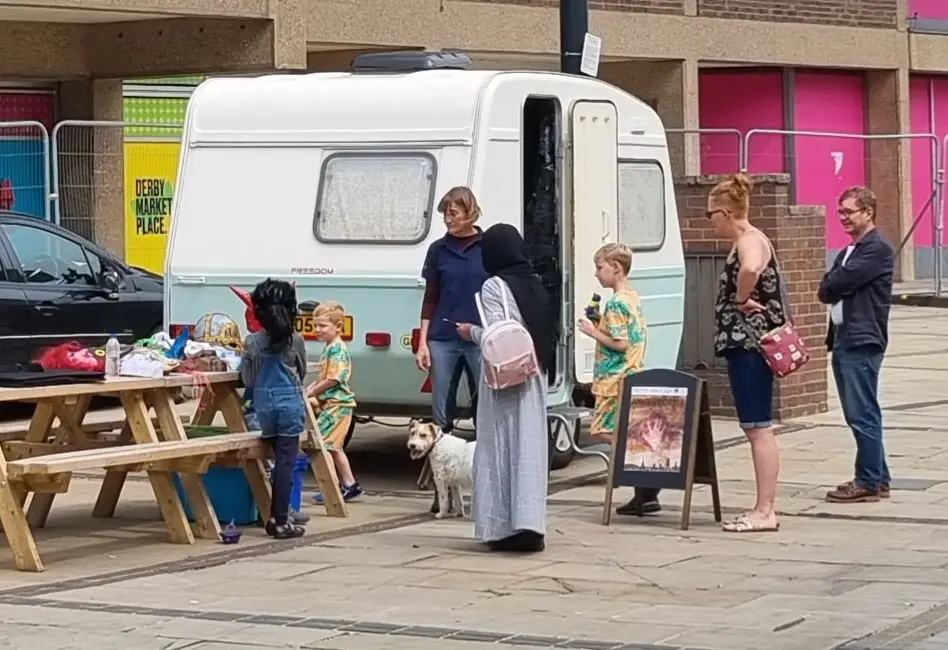
I found a caravan. Hollowed it out. Transformed it into a cave.
Inside, in the darkness, digital handprints glowed on the walls. When visitors touched them, artworks appeared: the masks, the paintings, the poems, the stories. It was prehistoric and futuristic simultaneously. You were in Lascaux and you were in a gallery and you were in someone’s memory, all at once.
Later, supported by Derby Museums, we transformed the entire experience into a fully immersive Virtual Reality installation. James Filby ( remember him, this project seriously changed his life) built the VR world. Visitors walked through a series of caves, discovering artworks hidden in the rock, inspired by the prehistoric cave paintings found across the world, from Chauvet to Altamira to Sulawesi. The message was layered into the medium: we have always been storytellers, we have always been travellers, and we have always left marks on walls to say I was here.
Here is what Ancestories taught me, beyond what any DNA kit could:
We are not who we think we are. Our neighbours are not who we think they are. And “they” are not who we think they are either. We are all travellers. We are all immigrants. Every single one of us came from the same place and arrived here via various meandering global journeys that took thousands of years and covered every continent.
The DNA kits are imperfect tools. They name things differently, they contradict on specifics, and they require more interpretation than their marketing acknowledges. But as a provocation, as a starting point for something deeper, they are extraordinary. They crack open the door to questions that most of us never think to ask about ourselves.
What surprised me most wasn’t the Japanese or Peruvian DNA in my own results. It was watching 18 people from Derby sit in a room together and slowly realise that their stories were not as separate as they’d assumed. That the Caribbean woman and the Romanian man and the Dagestani refugee and the Lancashire-born retiree were all, at some deep ancestral level, related. Connected. Fellow travellers.
Art didn’t prove that. Science did. But art is what made it felt.
If you’re expecting a neat answer to “who am I?”, you’ll be disappointed. What you’ll get instead is a mess of data that raises more questions than it answers, and that’s precisely why it’s worth doing.
My advice: take more than one test. Compare them. Do the work of cross-referencing. And then, once you’ve sat with the results for a while, do something creative with them. Write. Paint. Make a mask. Tell someone your story.
Because the science can tell you where your ancestors walked. But only you can decide what that journey means.
James Filby, Ancestories participant
Input your search keywords and press Enter.